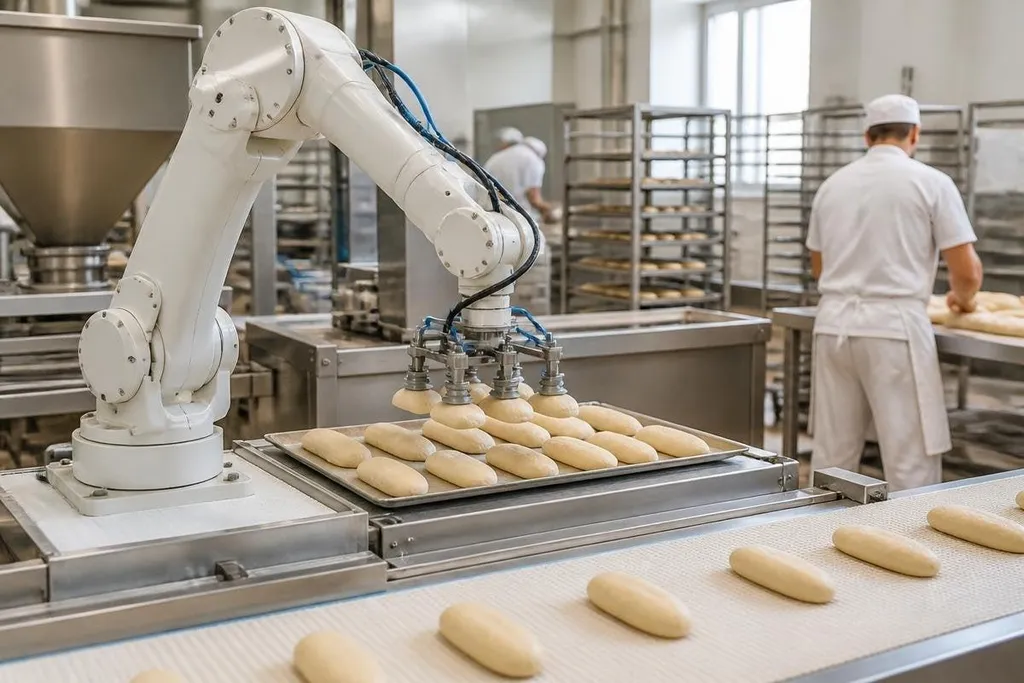
A bakery robot does not need to bake every loaf to change a production line. The useful work starts earlier, with tasks that repeat for every batch: portioning dough, moving trays, checking shape, and packing finished goods.
For bakery owners and plant managers, the practical question is where a robot can work safely beside ovens, mixers, conveyors, and people. The answer depends on the dough, the layout, and how much variation each product brings.
Quick read
- Robots fit best where the same movement happens across many batches.
- Dough handling is difficult because temperature, moisture, and elasticity change the result.
- A bakery still needs people for setup, quality checks, cleaning, and unusual jobs.
Where bakery robots do useful work
Portioning is a clear starting point. A dough divider cuts a large mass into smaller pieces, while a rounder shapes those pieces before proofing. The goal is consistent weight and shape, so each piece cooks at about the same rate.
Tray loading is another practical job. During this step, the robot can pick dough pieces or baked goods and place them in set positions. That keeps spacing steady and reduces the need for a person to repeat the same reach hundreds of times during a shift.
Packing comes after cooling. The robot can place bread, rolls, or pastries into boxes, bags, or trays when the product has a stable shape. Vision cameras can check position, color, or missing items before the package moves on.
These tasks work well because they have clear inputs and outputs. The robot receives a dough piece, tray, or package, then repeats a programmed motion within a defined work area.
Why dough makes automation difficult
Dough is not a fixed object. Flour type, water content, room temperature, and mixing time can change how it stretches or sticks. A gripper that works on one batch may press too hard on another.
That problem reaches past the robot arm. Sensors, software, conveyor timing, and cleaning routines all have to work together. A small change in dough behavior can cause pieces to stick, shift, or arrive at the next machine out of position.
Bakeries also handle many product shapes. A line making one standard loaf has a clearer task than a shop switching between buns, pastries, filled products, and seasonal items. Each change can need a new tool, program, tray pattern, or inspection rule.
This is why a robot may work well on one part of a bakery while people still handle the rest. Automation can repeat a known motion, but it still needs clear rules for changeovers and faults.
The people around the robot
The system does not remove the need for skilled staff. People still set recipes, check dough, clean food-contact surfaces, load materials, and decide what to do when a batch behaves differently.
Safety also shapes the layout. A robot arm needs a defined area, a stop system, and a way for staff to clear jams without reaching into moving equipment. Food hygiene adds another layer: surfaces must be easy to wash, and lubricants or loose parts must stay away from the product.
A bakery manager also needs to compare the robot with the work it replaces. Robotics reports from Robot24.com can name the machine, task, trial setting, and staff time recorded before the purchase cost enters the calculation.
The business case depends on the task. A robot may reduce repeated lifting or keep a line running at a steady pace, but the purchase cost is only one part of the decision.
Tooling, integration, staff training, maintenance, floor space, and cleaning time also affect the result.
A practical bakery automation check
Before choosing a robot, check these points:
- Name the task: Write down the exact movement, product, speed, and handoff point.
- Measure product change: Record how often dough size, shape, recipe, or packaging changes.
- Check the surface: Confirm that the gripper, belt, tray, and robot materials suit food contact and cleaning.
- Plan the fault: Decide how staff will clear a jam, replace a tool, or restart the line.
- Count the extra work: Add integration, training, service, energy, and cleaning to the equipment price.
- Run a real batch: Test the robot with the dough and packaging used in daily production, not a substitute material.
The strongest bakery projects will start with one repeatable task and a clear handoff to the next machine. My view is that owners should automate the movement that causes the most repeated strain first, then expand only after the line works through normal batches and changeovers.
That leaves the open question for each bakery: which task repeats often enough, and changes little enough, to justify a robot?